
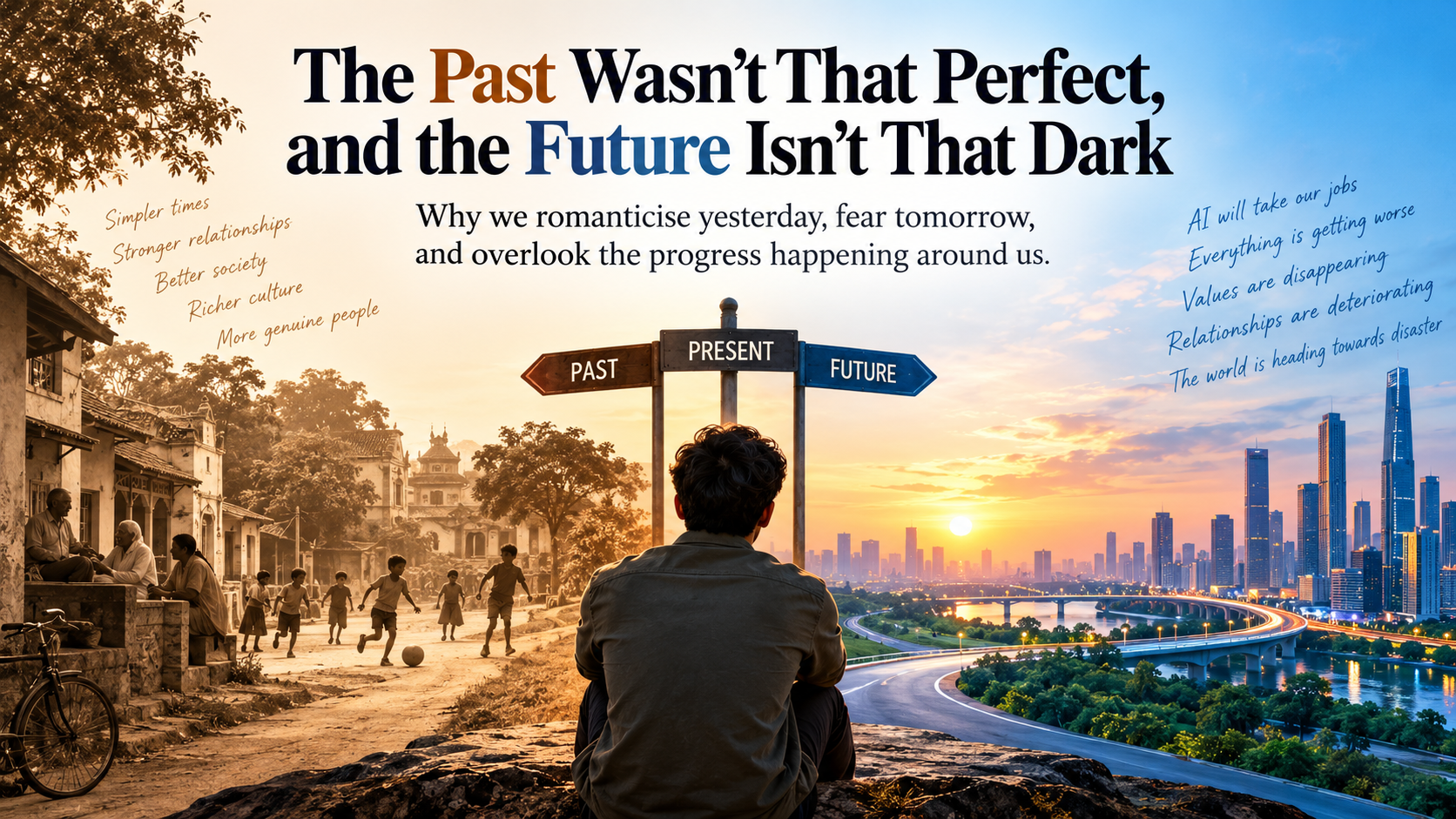
Almost every generation seems to believe that the world was a better place when they were younger.
Recently, on Sunday I was walking around my house and I met an uncle living in my neighbor. Around the surface level chitchat, he started telling me how everything was better in his time. People were more genuine, relationships were stronger, society had better values, children respected elders, and life was much simpler.
Then, within minutes, he started talking about the future.
“Nowadays, everything is getting worse. AI will take away jobs, relationships won’t survive, culture is disappearing, and the next generation has no future.”
I found it interesting.
The same person who remembered his past as almost perfect was convinced that the future would be terrible.
And I wondered, “Is the world really getting worse, or have we simply become better at remembering the good in our past and imagining the worst about our future?”
Perhaps the uncle was right about some things. Maybe relationships were more personal in certain ways. Maybe communities were more closely connected.
But the past also had its share of struggles, limitations, and problems. We had fewer medical facilities, fewer opportunities, lot more poverty and far less access to information.
Today, we can learn almost anything, connect with people across the world, access better healthcare, and build things that were unimaginable a few decades ago.
Yet, we barely notice these improvements because they have become part of our everyday lives.
Maybe that’s the problem.
“We romanticise the past, catastrophise the future, and underestimate the present.”
Are we looking at the past through the comforting lens of memory, the present through the frustrations of everyday life, and the future through the magnifying glass of our anxieties?
Perhaps the world is neither as perfect as we remember it nor as terrible as we predict. Perhaps we have become so accustomed to noticing what is disappearing and what might go wrong that we have stopped paying attention to what is improving.
This is not an argument against remembering the past or worrying about the future. It is an argument for seeing both more clearly.
let’s look at it one by one to understand the pattern.
1. The Psychology of a Glorified Past
There is a reason the past often feels better than the present, even when the facts do not entirely support that feeling. Psychologists have studied a phenomenon known as rosy retrospection: the tendency to remember past experiences more positively than we experienced them at the time.
In a 1997 study published in the Journal of Experimental Social Psychology, researchers examined people’s experiences of holidays and trips. They found that participants’ memories of these experiences became more positive than their evaluations during the actual events.
Think about your own life.
When you remember your school days, you might recall friendships, carefree afternoons, cricket matches, family gatherings and the excitement of festivals. But you may not remember with equal intensity the pressure of examinations, financial limitations, family restrictions, or the things you desperately wanted but could not have.
The good memories remain vivid. The uncomfortable details gradually lose some of their emotional intensity. The same process can happen when we remember an entire era.
Someone who grew up in the 1980s or 1990s might remember a neighbourhood where children played together until sunset, neighbours knew one another, and festivals brought everyone together. Those memories may be entirely genuine.
But that same period also had its limitations: fewer medical options, less convenient communication, limited access to information, and fewer opportunities for many people who wanted to study, work or live independently.
The person remembers the warmth of the community, not necessarily every constraint of the society.
Nostalgia is not necessarily a lie. It is an incomplete account of the truth.
The problem begins when we take our personal memories and turn them into universal conclusions about the superiority of an entire era.
Your childhood may genuinely have been wonderful. That does not automatically mean childhood was better for everyone in your generation, or that life was better for society as a whole.
2. Why Does Every Generation Believe That Things Were Better Before?
One of the most interesting features of human history is that complaints about the decline of society are not new.
Older generations often complain that younger people lack discipline, respect, patience or commitment. They worry that cultural values are disappearing and that the next generation is becoming increasingly self-centred.
But previous generations made similar complaints about the generations before them.
The specifics change, but the underlying concern remains remarkably familiar.
Today, the complaint might be that smartphones have destroyed children’s attention spans. A generation earlier, people worried about television. Before that, concerns surrounded cinema, radio and other new forms of entertainment.
This does not mean every concern is baseless. Technology can create real problems. But it does suggest that we should be careful before treating every cultural change as evidence of civilisational decline.
There are at least three reasons why this pattern persists.
First, familiarity creates comfort. We tend to understand the social rules, technology and expectations of the era in which we grew up. As society changes, the familiar becomes less dominant, and the unfamiliar can feel like deterioration.
Second, people often compare different stages of life. When an older person says life was better 30 years ago, they may be comparing their youth with their present adulthood. They remember the energy, friendships and possibilities of being young, but compare them with today’s responsibilities, uncertainty and physical limitations.
Part of what they miss may not be the world as it was. It may be who they were in that world.
Third, we become attached to the standards of our own generation. The music we grew up listening to, the friendships we formed and the traditions we followed become part of our identity. When these things change, it can feel as if something valuable is being lost.
But cultural change and cultural decline are not the same thing.
A new generation may express affection differently, communicate differently or choose different careers without necessarily being less caring, less intelligent or less committed than the generation before it.
The challenge is to distinguish what has genuinely deteriorated from what has simply changed.
3. The Future Has Become a Convenient Target for Our Fears
If the past receives the benefit of nostalgia, the future often receives the burden of our anxiety.
We imagine the worst possible consequences of change and then begin treating those possibilities as inevitable outcomes.
Artificial intelligence will eliminate all meaningful work. Social media will destroy every genuine relationship. Climate change will make life unbearable. Young people will abandon all traditional values. Human beings will become increasingly isolated.
Some of these concerns involve serious risks. Others are exaggerated. Many depend on decisions that have not yet been made.
Yet, in everyday conversations, the distinction between something could go wrong and everything will go wrong frequently disappears.
Research on public attitudes offers an interesting example.
In an April 2023 analysis, Pew Research Center reported that 58% of surveyed American adults believed life was worse than 50 years earlier for people like them, while only 23% believed it was better. The survey also found widespread pessimism about the country’s future.
More recently, in a survey conducted in December 2025 and reported in May 2026, 59% of Americans said their country’s best years were behind it, compared with 40% who believed they were ahead. Asked about the country 50 years from then, 44% expressed pessimism and 28% optimism.
These are findings about American public opinion, not proof that every society or every individual thinks the same way. But they illustrate how readily the belief that the past was better can coexist with the expectation that the future will be worse.
Why does this happen?
Because the future is uncertain, and uncertainty gives our imagination room to construct disasters.
We know today’s problems because we can see them. We know yesterday’s problems through the filter of memory. But tomorrow’s problems arrive in the form of possibilities, and our minds can keep generating them without needing evidence that they will actually occur.
Consider artificial intelligence.
We can reasonably worry about job displacement, misinformation, privacy, security and the concentration of economic power. These are genuine issues that deserve serious attention.
But the same technology may also help people learn new skills, improve medical research, automate repetitive work, develop businesses and access services that were previously expensive or unavailable.
Which future will emerge?
That depends partly on how the technology develops, how institutions respond and how people adapt.
To assume that only the negative outcomes will materialise is no more rational than assuming that every technological promise will be fulfilled.
Pessimism often presents itself as realism, but expecting the worst is not the same as understanding the future.
Realism requires us to evaluate both the risks and the opportunities.
4. The Facts Tell a More Complicated Story Than Our Memories
If we want to know whether the world has improved, we should look beyond anecdotes and examine measurable outcomes.
History is not a story of uninterrupted progress. Wars, economic crises, pandemics, political failures and environmental damage have caused enormous suffering. Some problems are worsening, and many people remain excluded from the benefits of development.
Nevertheless, across several important dimensions, humanity has made extraordinary progress.
Healthcare: Living longer has become normal in a way it once wasn’t in earlier eras
Infectious diseases, limited treatments and high risks for mothers and children.
Today, Vaccines, antibiotics, advanced diagnostics and much better emergency care.
According to Our World in Data, global life expectancy at birth increased from approximately 32 years in 1900 to around 71 years in 2021. The improvement reflects advances in medicine, sanitation, nutrition, public health and living standards.
This does not mean people in the past never lived to an old age. Many did. Life expectancy at birth was low partly because so many children died young, and mortality risks were higher across many age groups.
The larger point is that a child born today, in many parts of the world, has a much better chance of surviving childhood and living a long life than a child born a century ago.
Think about what this means for an ordinary family.
A serious infection that once carried a substantial risk of death may now be treatable. A complicated pregnancy may be managed with modern medical support. A disease that once required a long journey to a specialist may be detected through increasingly accessible diagnostic services.
Modern healthcare is still unequal, expensive in many places and far from perfect. But comparing its capabilities with those of previous generations reveals just how much has changed.
When someone says that life was better in the old days, it is worth asking a simple question: would they willingly give up the medical knowledge and treatments available today?
Most would not.
Poverty and living standards: Progress is real, but incomplete
The World Bank reports that India’s economy has grown substantially over the past two decades, with real GDP nearly quadrupling since 2000 and per capita income almost tripling. It also reports that the share of India’s population living below the international extreme-poverty threshold of $3 per day, measured in 2021 purchasing-power-parity terms, declined from 16.2% in 2011–12 to 2.3% in 2022–23.
A person can now access information, compare prices, learn skills, communicate with distant relatives and conduct financial transactions through a device in their pocket.
Millions of people who once faced significant barriers to information and financial services now have access to tools that previous generations could hardly imagine.
That is meaningful progress, even if the benefits are distributed unequally.
5. The Past May Have Been Simpler, but Simpler Did Not Always Mean Better
One of the most common arguments for the superiority of the past is that life was simpler.
People met in person. Families spent more time together. Children played outdoors. Neighbours knew one another. Festivals were celebrated collectively. There was less digital distraction.
There is truth in much of this.
Modern life can be fragmented by constant notifications, demanding work schedules, social comparison and an endless stream of information. Technology can consume our attention without necessarily improving the quality of our relationships.
But we should be careful not to confuse the simplicity of an earlier lifestyle with the overall quality of life in that era.
Some forms of simplicity existed because people had fewer choices.
A young person might have followed the career chosen by their family because alternatives were inaccessible. A woman might have depended financially on her husband because employment opportunities were limited. A person might have remained in an unhappy marriage because separation carried significant social or economic costs.
People could be more closely connected to their communities while simultaneously having less freedom to make personal choices.
A tightly knit society can provide belonging, support and security. It can also impose conformity, social pressure and restrictions on individual expression.
Both realities can exist at the same time.
Similarly, modern individualism can offer freedom and independence, but it can also weaken shared responsibilities if people become excessively self-focused.
The question, therefore, is not whether the past or present is inherently superior. It is which features of each era improve human well-being.
We can preserve the community spirit of earlier generations while embracing the freedom and opportunities of the present.
We can value family relationships without imposing outdated expectations. We can celebrate cultural traditions without rejecting social progress. We can use technology without allowing it to control our lives.
The goal should not be to return to the past. It should be to retain what was valuable and improve what was not.
6. We Notice What Is Disappearing More Easily Than What Is Emerging
Imagine two people discussing the future of education.
The first says that children no longer need to memorise facts because information is available online. They worry that students are losing discipline and becoming dependent on technology.
The second points out that a student in a small town can now access lectures, books and educational resources that were once available mainly to people with access to well-equipped institutions.
Both observations can be true.
Digital tools can encourage shallow learning, distraction and overdependence. They can also expand access to knowledge and provide new ways to understand difficult subjects.
The mistake is to acknowledge only one side of the equation.
This pattern appears in almost every area of life.
- We notice that traditional retail businesses are closing, but overlook the opportunities created by e-commerce.
- We notice that automation may displace certain jobs, but overlook the new roles, industries and services it may enable.
- We notice that people spend more time communicating through screens, but overlook the ability to maintain relationships across countries and continents.
- We notice that some traditional occupations are disappearing, but overlook the possibility of new career paths that did not previously exist.
None of these examples guarantees that the transition will be painless or that everyone will benefit equally. Workers can lose livelihoods, small businesses can struggle, and communities can suffer when industries decline.
Progress often creates winners and losers, and society has a responsibility to help people navigate those transitions.
7. The Negativity Bias: Why Bad News Commands So Much Attention
There is another reason we may underestimate progress: negative events tend to attract our attention.
A report about a violent crime, a financial scam, a political controversy or a technological failure can generate an immediate emotional reaction.
A report about a gradual decline in child mortality, improved access to electricity or the expansion of digital services may receive far less attention.
This is partly a feature of how people process information, and partly a feature of how news and social media compete for attention.
Threats demand attention. A potential danger feels urgent because ignoring it could have consequences.
But when this instinct combines with an information environment full of dramatic headlines, it can distort our perception of how the world is changing.
Consider the difference between these two statements:
- A new form of fraud has emerged, and people need to learn how to protect themselves.
- Millions of people are now able to make convenient digital payments, but the development attracts little attention because it has become routine.
The first is a compelling story about an immediate threat. The second describes a broad change that may have taken years to develop.
The threat may deserve urgent attention. The improvement deserves recognition too.
The problem is not that negative news exists. It is that the volume and emotional intensity of negative information can cause us to mistake the most visible problems for the entire state of the world.
We hear about what has gone wrong today, but rarely compare it with the full range of problems people faced decades ago.
We count the failures of the present while remembering the successes of the past.
That is not a fair comparison.
A better assessment would ask: What has improved? What has deteriorated? Who has benefited? Who has been left behind? Which problems are new, and which old problems have become less severe?
Such questions produce a more complete picture than either blind optimism or habitual pessimism.
8. The Present Is Often the Least Appreciated Part of Our Lives
There is an irony in the way we evaluate time.
When we are young, we often look forward to adulthood. We want financial independence, professional success, freedom and recognition.
When we become adults, we sometimes look backwards and wish we could return to the simplicity of our younger years.
We spend one phase of life waiting for the next, then spend the next phase longing for the previous one.
The same pattern can occur at the level of society.
People living through a period of technological change may focus on the inconvenience and uncertainty of the transition. Decades later, their children may regard the same period as the beginning of a remarkable transformation.
The people who lived through the early years of the internet had to deal with slow connections, limited access and unfamiliar tools. Over time, those technologies transformed communication, education, commerce and entertainment.
The transformation was neither entirely positive nor entirely negative. But many of its most consequential benefits became apparent only after the technology became integrated into everyday life.
This suggests that we may be poorly positioned to evaluate the present while we are living through it.
We experience the frustrations directly, while the long-term benefits remain uncertain. We notice the costs of adaptation before we understand the full value of what is emerging.
This does not mean we should automatically assume that every change will eventually prove beneficial. Some changes genuinely make life worse.
It means that we should resist making sweeping judgments about an entire era based solely on the discomforts we experience during it.
The present may be imperfect. It may also contain opportunities that we will recognise only in retrospect.
Perhaps one day, people will look back at today’s world and admire things we currently take for granted: the ability to communicate instantly across continents, access vast amounts of knowledge, use sophisticated medical treatments, or build a business with tools that once required enormous resources.
They may also criticise us for problems we have failed to solve.
Both assessments may be justified.
Our task is to make the most of the present rather than spend it endlessly mourning the past or fearing the future.
Then, How Should We Think About the Past, Present and Future?
A healthier perspective begins by assigning each period its proper role. Have rational and balanced approach while thinking. Staying away from Doomsday fallacy and looking at what might be the good and what mankind is capable of doing would be a great start.
The past should be a source of memory and learning, not a permanent refuge from the present.
We should preserve its wisdom, traditions and valuable experiences. But we should also examine its failures honestly, rather than assume that age makes every practice superior.
The present should be a source of awareness and action.
We should recognize the opportunities available to us, appreciate what is working, address what is not and avoid taking ordinary conveniences for granted.
The future should be a source of preparation and possibility.
We should anticipate risks, develop new capabilities, make thoughtful investments and work towards outcomes that improve human well-being.
Each period offers something different.
- The past gives us experience.
- The present gives us agency.
- The future gives us direction.
Problems arise when we ask one period to perform the role of another: when we expect the past to provide all the answers, the present to be free of discomfort, or the future to guarantee our security.
A more constructive mindset asks three questions.
What can I learn from the past?
Not merely what do I miss, but what was genuinely valuable, what failed, and what should be done differently?
What can I appreciate and improve today?
Not merely what is wrong, but what is working, what opportunities are available, and what actions can make life better?
What can I do to influence the future?
Not merely what could go wrong, but what skills, institutions, relationships and innovations can help create a better outcome?
These questions move us away from passive nostalgia and anxiety towards informed action.
Conclusion: Stop Mourning Every Change and Start Recognising Progress
Because the world does not become better merely because we believe it will. Nor does it become worse merely because we expect it to.
It becomes better when we recognise what is wrong, understand what is working, and have the courage to build on the latter while correcting the former.
And that begins with how we choose to see the world today.
Sources and further reading
The following sources support the article’s psychological argument and historical examples.
- Rosy retrospection: Mitchell et al., Temporal Adjustments in the Evaluation of Events: The “Rosy View” (1997). Read the research abstract.
- Global life expectancy: Our World in Data, historical trends in life expectancy and the role of medical and public-health advances. Explore the data and analysis.
- Public attitudes towards the past and future: Pew Research Center, Americans take a dim view of the nation’s future, look more positively at the past (2023). Read the survey analysis.
- Recent American views of the future: Pew Research Center, A majority of Americans say the country’s best years are behind us (2026). Read the 2026 findings.
- India’s economic progress and continuing challenges: World Bank, India country overview. Read the World Bank overview.