

How Affordable Satellite Internet Could Supercharge India’s Digital Boom
On March, 2025, India stands at a digital crossroads. With over 950 million internet users, it’s already the world’s second-largest online market. Yet, nearly 450 million people, many in rural and remote areas, remain disconnected, leading to a digital divide that traditional infrastructure struggles to bridge.
The Starlink, Elon Musk’s ambitious satellite internet venture from SpaceX, promising high-speed connectivity directly from the skies. If Starlink can crack the affordability code, it might not just connect the unconnected; it can ignite an unprecedented digital boom in India.
The Promise of Starlink
Starlink’s low Earth orbit (LEO) satellite network offers internet speeds of 50 to 200 Mbps (with potential to hit 300 Mbps), bypassing the need for costly fiber optic cables or mobile towers. For India’s hinterlands, where broadband penetration hovers at a mere 9–10%, this could be transformative. Imagine a farmer in state of Bihar accessing real-time crop prices, a student in Ladakh streaming online classes, or a doctor in Assam delivering telemedicine during floods. This isn’t just connectivity; it’s empowerment, aligning seamlessly with the Digital India vision.
Beyond rural reach, Starlink could bolster disaster resilience, providing a lifeline when terrestrial networks crumble under natural calamities, a frequent reality in India.
The Affordability Hurdle
But here’s the catch: Starlink’s current pricing, estimated at ₹37,400 for equipment and ₹7,425 monthly (excluding taxes), is a steep climb in a country where mobile data costs less than $0.20 per GB. For the average rural household, this is a luxury, not a utility. Urban users, spoiled by cheap 5G and fiber, might scoff too. Without affordability, Starlink risks becoming a niche service for businesses and the elite, rather than the mass-market game-changer it aspires to be.
Yet, if Starlink can slash costs, through subsidies, partnerships, or localized manufacturing, the story changes dramatically. Recent tie-ups with Airtel and Jio, announced in March 2025, hint at such a shift. Imagine a subsidized ₹1,000 kit and ₹500 monthly plans, bundled with local telecom offerings. Suddenly, millions more could log on, turbocharging India’s digital economy.
Accelerating the Digital Boom
India’s digital ascent is already remarkable: 105.85 Mbps average download speeds, a thriving startup ecosystem, and booming e-commerce. Affordable Starlink could take this to the next level:
- Economic Explosion: Small businesses in Tier-3 towns and villages could go global, selling handicrafts or produce online. Farmers could leverage agritech apps for precision farming, boosting yields and incomes. McKinsey estimates that closing India’s digital divide could add $500 billion to its GDP by 2030; Starlink could fast-track that.
- Education Revolution: With 250 million schoolchildren, India’s edtech sector is ripe for growth. Affordable satellite internet could bring quality education to remote classrooms, reducing urban-rural learning gaps and nurturing a skilled workforce.
- Healthcare Leap: Telemedicine, already growing post-COVID, could reach every corner. Affordable connectivity means more patients consulting specialists online, cutting travel costs and improving outcomes.
- Innovation Surge: Startups could flourish beyond metros, tapping into a newly connected talent pool. From fintech in Jharkhand to health-tech in Uttarakhand, the possibilities are vast.
The Challenges Ahead
Affordability isn’t the only hurdle. Regulatory delays loom large: Starlink’s GMPCS license, applied for in 2022, awaits clearance amid security concerns. The government worries about data sovereignty (with servers potentially abroad) and misuse by insurgents, as seen with seized kits in Manipur in 2024. Telecom rivals argue Starlink’s administrative spectrum allocation undercuts their auction-based investments, sparking a policy tug-of-war. Environmentalists and astronomers also flag space debris and light pollution from its 7,000+ satellites.
Geopolitically, a U.S.-based service raises eyebrows. Could Starlink give Washington undue influence over India’s internet? Posts on X reflect this unease, with some fearing “zero control” over a critical resource. India must balance these risks with its need for technological leaps.
While satellite internet avoids the need for ground infrastructure, it still requires users to install a satellite dish and have a clear view of the sky, which could be cumbersome in densely populated or geographically challenging areas.
The Bigger Picture
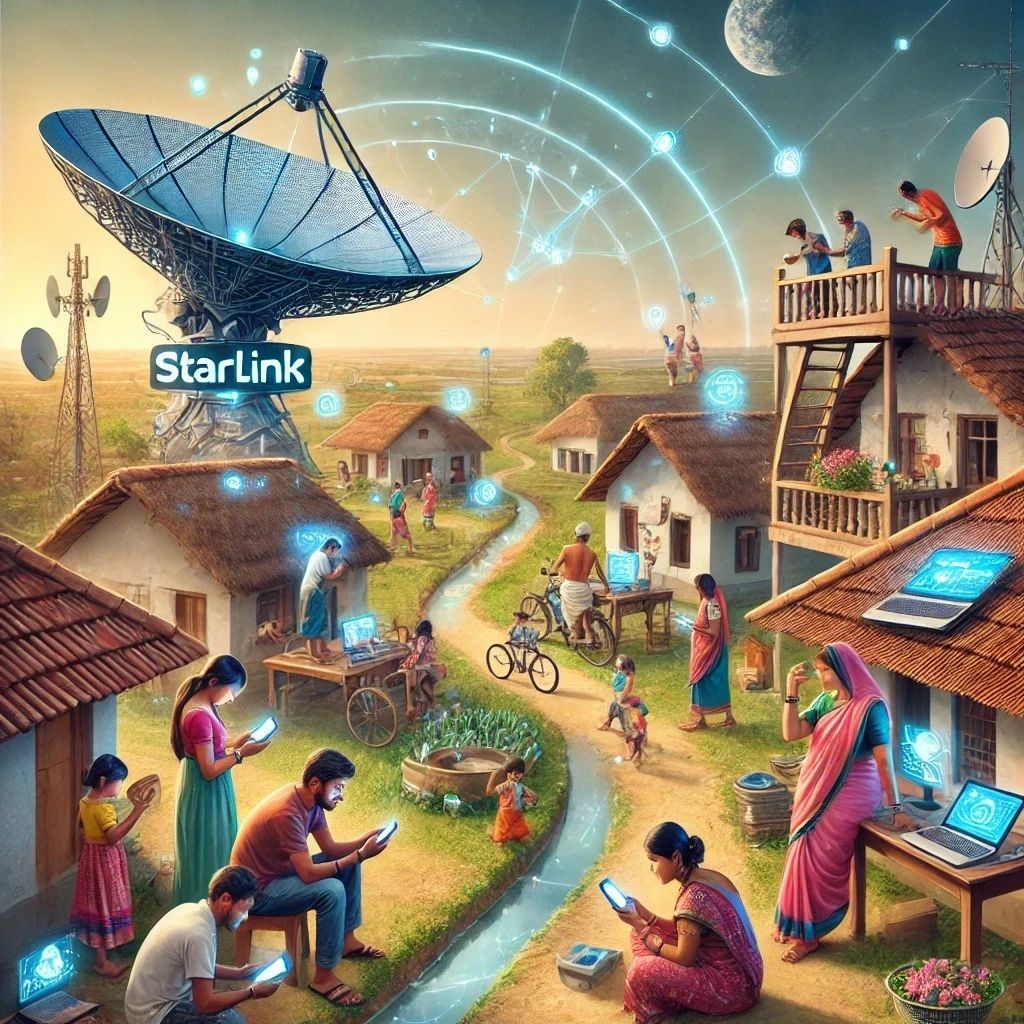
Starlink won’t replace cheap mobile data or urban fiber anytime soon. Its sweet spot is where others falter: rural plains, Himalayan peaks, and disaster zones. Affordable Starlink could amplify India’s digital boom, not by competing with Jio’s 5G or Airtel’s fiber, but by complementing them, stitching together a truly connected nation.
The stakes are high. If Starlink navigates affordability and regulation, it could light up India’s skies, and its future. If not, it risks being a fleeting comet, dazzling but distant. For a country racing toward a $5 trillion economy, the choice is clear: make it work, and let the digital revolution soar.